If you are searching for what is a crypto wallet, the short answer is this: a cryptocurrency wallet is software or hardware that manages the cryptographic keys used to control digital assets on a blockchain. It does not typically “store coins” the way a physical wallet stores cash. Instead, the blockchain records balances, and the wallet helps you prove ownership and authorize transfers.
This guide is educational only. It is not financial, legal, tax, or investment advice. Cryptocurrency involves significant risk, including the possibility of permanent loss from scams, user error, malware, exchange failures, or market volatility. Always verify information from primary sources and consider consulting qualified professionals before making decisions about money or security.
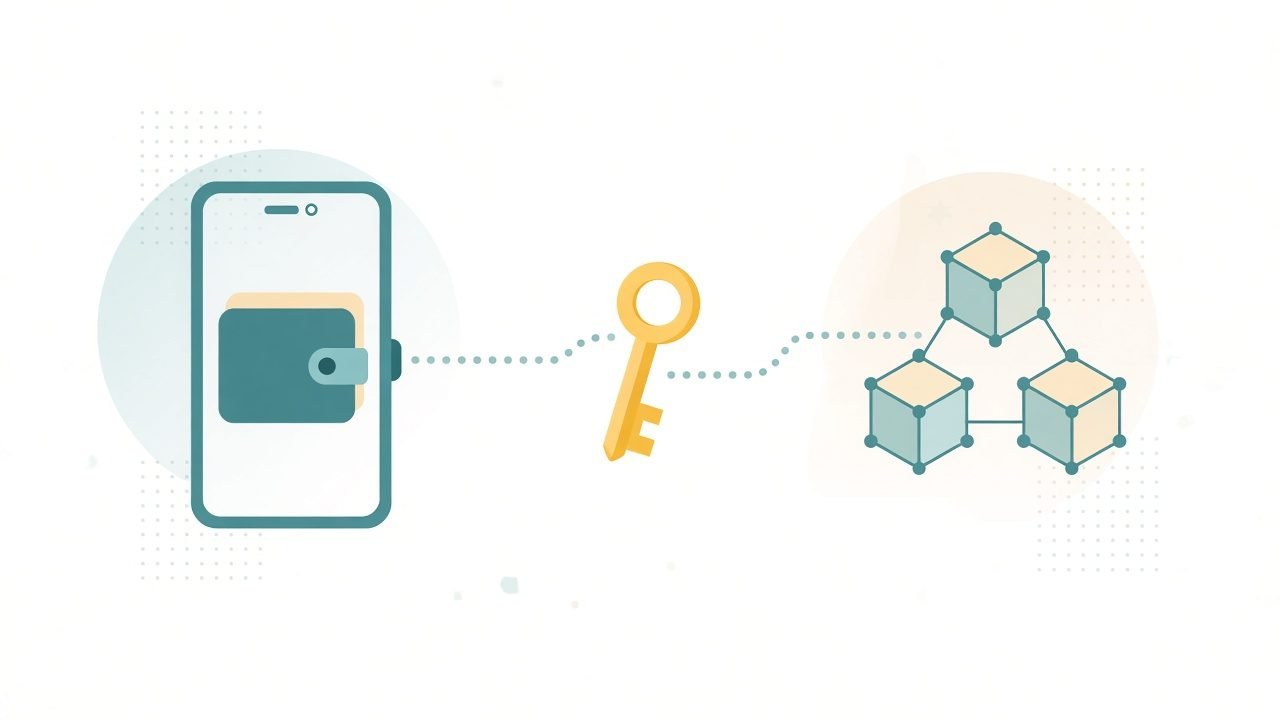
Crypto wallet meaning in plain language
The crypto wallet meaning that matters most for beginners is control of keys. When people say they “have Bitcoin in a wallet,” they usually mean their wallet software can sign transactions for addresses associated with those keys. The network itself keeps the ledger. Lose the keys (or lose access to a custodial account that holds keys for you), and you may lose the ability to move those assets—often with no recovery path.
A useful analogy: think of a blockchain address like a mailbox number anyone can see, and the private key like the only key that opens that mailbox. A wallet is the tool that keeps track of keys, generates addresses, builds transactions, and shows balances by reading the public ledger. The analogy is imperfect, but it clarifies why “wallet” is a common word and still slightly misleading.
Cryptocurrency wallet explained: keys, addresses, and the ledger
A cryptocurrency wallet explained at a technical-but-readable level usually includes these pieces:
- Private keys — secret data that authorizes spending or transferring assets. Anyone who obtains a private key can typically move funds associated with it.
- Public keys / addresses — derived information you can share so others can send you assets. Addresses are often shown to users; private keys should never be shared.
- Transaction signing — the wallet creates a transaction and uses the private key to produce a cryptographic signature. Networks verify the signature without needing to reveal the private key.
- Balance display — wallets query blockchain data (directly or through providers) to show what amounts are associated with your addresses.
Modern wallets often start from a recovery phrase (sometimes called a seed phrase) rather than asking you to manage raw private keys one by one. Many widely used wallets follow industry seed-generation concepts associated with standards such as BIP39 (a Bitcoin Improvement Proposal that describes mnemonic phrases). Mentioning BIP39 here is conceptual: it is a well-known naming convention in wallet design, not a recommendation to use any particular product, and you should verify details from official standards documentation if you need implementation-level accuracy.
Some wallets also support passphrases, account hierarchies, and multi-coin derivation paths. Beginners do not need every detail on day one, but they should understand that a recovery phrase is extremely sensitive. Anyone who copies it can often recreate the wallet elsewhere.
Digital wallet crypto vs everyday payment apps
People sometimes confuse a digital wallet crypto setup with consumer payment apps that store card details or bank balances. The surface experience can look similar—an app, a balance, a send button—but the risk model is different.
With many traditional payment apps, institutions, card networks, and customer support systems sit behind disputes and account recovery. With self-custody crypto wallets, recovery is usually your responsibility. If you delete an app without backing up your recovery phrase, funds may still exist on-chain, but you may have no practical way to access them. If someone steals your phrase, transfers can be irreversible.
Custodial platforms (discussed below) can look more like traditional accounts, with logins and password resets. That convenience can come with counterparty risk: you depend on the platform’s security, policies, solvency, and compliance processes.
A brief background: why wallets became central to crypto
Early cryptocurrency users managed keys with simple software or even offline methods. As ecosystems grew, wallets evolved into apps, browser extensions, and dedicated devices. Exchanges and brokerages also became common entry points, especially in the United States, where many people first buy crypto through an account rather than generating their own keys.
This history matters because “wallet” now covers several different products:
- Software that holds keys on a phone or computer
- Hardware devices that keep keys offline and approve signing
- Custodial accounts marketed with wallet-like interfaces
- Multi-signature setups used by teams or advanced users
When reading marketing pages, ask: who controls the private keys, and what happens if that party disappears, gets hacked, or freezes access?
Hot wallets and cold wallets: a short orientation
You will often see wallets described as “hot” or “cold.” A full comparison deserves its own article; this section is only a brief orientation so the core definition stays clear.
Hot wallets stay connected to the internet or run on internet-connected devices. They are convenient for smaller, frequent activity. Because they live in online environments, they face malware, phishing, and device-compromise risks.
Cold wallets keep private keys offline most of the time. Hardware wallets are a common consumer form of cold or near-cold storage: keys stay on a dedicated device, and signing happens with physical confirmation. Cold storage reduces certain remote-attack risks, but it does not eliminate physical theft, supply-chain issues, user mistakes, or social engineering.
Neither category is automatically “safe.” Security depends on threat model, setup quality, backup practices, and operational habits. A carefully managed hot wallet can be appropriate for limited amounts; a poorly set up cold wallet can still lead to total loss.
Custodial vs non-custodial (self-custody) overview
Understanding custodial versus non-custodial arrangements is essential to the crypto wallet meaning used by educators and security writers.
Custodial wallets / custodial accounts A third party holds the keys (or otherwise controls spending authority) on your behalf. You typically access funds with a username, password, and possibly multi-factor authentication. Pros can include easier onboarding, password recovery workflows, and integrated buying/selling. Cons include dependence on the custodian. If the platform is breached, insolvent, or restricts withdrawals, your ability to move assets may be limited. Regulatory protections vary by jurisdiction and product type; do not assume crypto balances are insured like conventional U.S. bank deposits unless a specific, verified protection applies.
Non-custodial / self-custody wallets You (or your devices and backups) control the keys. No company needs to approve an ordinary send transaction. Pros include direct control and reduced reliance on a single platform’s operational health. Cons include full personal responsibility for backups, device hygiene, phishing resistance, and inheritance planning. Mistakes can be permanent.
Hybrid and “smart account” designs continue to evolve, including social recovery and institutional custody models. For beginners, the practical question remains: if I want to move assets right now, whose approval is required, and what secrets must stay private?
What a wallet does not do
Clearing misconceptions prevents costly errors:
- A wallet does not magically protect you from sending assets to the wrong address.
- A wallet does not guarantee that a token, NFT, or contract interaction is legitimate.
- A wallet interface does not always show every risk of a smart-contract approval.
- A wallet brand name does not replace your obligation to verify download sources and URLs.
- Seeing a balance in an app does not prove the app is trustworthy; malware can mimic interfaces.
Also remember: blockchain transactions are typically public. Privacy expectations differ from cash. Address reuse, exchange deposits, and on-chain analytics can link activity in ways beginners do not expect.
Risks you should take seriously
Discussing what is a crypto wallet without discussing risk would be incomplete. Common risk categories include:
- Phishing and fake support — attackers imitate wallet sites, apps, pop-ups, or “support agents” asking for recovery phrases.
- Malware and clipboard hijacking — compromised devices can alter destination addresses or steal secrets.
- Backup failure — no durable, private backup of a recovery phrase can mean irreversible lockout.
- Physical compromise — stolen phones, laptops, or hardware devices, especially if PINs or passphrases are weak.
- Custodial failure — hacks, insolvency, withdrawal freezes, or account lockouts.
- User authorization mistakes — approving malicious smart contracts or signing misleading transaction data.
- Social engineering — romance scams, investment-group pressure, or “drainers” that trick users into signing harmful messages.
- Market and liquidity risk — separate from wallet mechanics, but relevant if you hold volatile assets.
No checklist removes all risk. The goal is informed caution, not false confidence.
What beginners should do next
If you are new and mainly trying to understand wallets before taking action, a sensible learning path looks like this:
- Decide your goal. Are you exploring concepts, buying a small amount through a regulated intermediary, or preparing for self-custody? Your goal changes the right first tool.
- Learn the key principle. Wallets manage keys; blockchains record balances. Write that down until it feels natural.
- Practice with low stakes. If you later create a self-custody wallet, consider treating early practice as an educational exercise with amounts you can afford to lose entirely. Label this as a hypothetical approach: for example, a learner might create a wallet, send a tiny test amount between two addresses they control, then practice restoring from a backup on a spare device—only after understanding that mistakes can still be costly.
- Separate “learning setup” from “long-term storage plan.” Beginners often mix convenience and security too early. It is reasonable to learn interface basics before designing cold storage.
- Document your recovery plan privately. For self-custody, that means understanding where backups live, who can access them, and what happens if you become unavailable. Avoid cloud screenshots and shared notes for recovery phrases.
- Verify every download and URL. Prefer official project sites and known app stores, then cross-check with multiple reputable references. Be skeptical of sponsored search ads that imitate brand names.
- Enable strong account security on custodial platforms. Use unique passwords and phishing-resistant multi-factor authentication where available. Still remember that account security is not the same as self-custody.
- Read fee and network basics. Sending on busy networks can be expensive; choosing the wrong network for a transfer is a frequent beginner loss scenario.
- Plan for taxes and records if you are in the United States. Wallet activity can create taxable events depending on your facts and circumstances. Keep records; seek a qualified tax professional for personal guidance.
- Keep learning in layers. After definitions, study seed phrases, hot vs cold tradeoffs, and scam patterns—one topic at a time.
Common mistakes beginners make
These mistakes appear repeatedly in educational materials and incident reports across the industry. Treat them as cautionary patterns, not as personal claims about any individual’s experience:
- Sharing a recovery phrase with anyone, including people claiming to be support staff.
- Typing a recovery phrase into a website that “validates,” “syncs,” or “fixes” a wallet.
- Buying hardware from unverified resellers without checking for tampering guidance from the manufacturer.
- Storing backups in email, photo galleries, or synced notes.
- Reusing the same wallet setup for tiny experiments and life savings without threat modeling.
- Blindly approving wallet pop-ups during airdrops, mints, or “free claim” links.
- Sending funds on the wrong network or to an address format that does not match the destination’s instructions.
- Assuming screenshots of balances prove ownership or prove a platform is safe.
- Ignoring software updates or, conversely, installing updates from unofficial channels.
- No inheritance or emergency plan, leaving families unable to locate legitimate access instructions.
Practical recommendations (educational, not personalized advice)
The following recommendations are general education for a U.S. beginner audience. They are not a promise of safety and not a recommendation to buy, sell, or hold any asset.
- Start with definitions before deposits. Make sure you can explain, in your own words, the difference between an exchange account and a self-custody wallet.
- Use official sources only. For CryptoWealth.io context and company background, start from pages you can verify directly, such as https://cryptowealth.io/about-us/. For wallet software or hardware, verify vendor documentation yourself; do not trust random DMs.
- Prefer small tests before large transfers. Example (hypothetical): if Alice is moving funds from an exchange account to a self-custody address, she might withdraw a small test amount first, confirm receipt, then proceed—knowing fees still apply and that this process does not remove all risk.
- Protect the recovery phrase like a master key. Offline, private, durable backups beat clever but exposed storage.
- Minimize secrets on internet-connected devices. The more often private keys or phrases appear on a general-purpose phone or PC, the broader the malware risk.
- Be wary of urgency. Scams often create time pressure: fake legal threats, “limited” giveaways, or support panic.
- Review permissions. In ecosystems with token approvals, learn how allowances work before interacting with unfamiliar contracts.
- Keep expectations realistic. A wallet can improve control and transparency of key management; it cannot guarantee profits or eliminate human error.
- Revisit your setup as your holdings or threat model change. What is acceptable for a learning balance may be inappropriate for larger amounts.
How to evaluate a wallet product without hype
When comparing options later, ask structured questions:
- Who holds the keys?
- How are backups created and restored?
- What chains and asset types are supported, and what are the failure modes if you pick the wrong network?
- How does the wallet show transaction details before signing?
- What data is shared with third-party nodes or analytics providers?
- What is the vendor’s update and disclosure track record?
- Are you comfortable with the device and operational requirements?
Avoid choosing solely based on aesthetics, influencer promotion, or promised yields. Yield features, wrapping, and “earn” tabs can introduce smart-contract and custodial risks beyond basic wallet storage.
Putting the definition to work
By now, what is a crypto wallet should map to a concrete mental model: a key-management tool for blockchain assets, available in custodial and self-custody forms, with hot and cold deployment styles, and with irreversible-error potential. The phrase cryptocurrency wallet explained is really a security lesson wrapped in product language. Digital wallet crypto tools can feel as simple as a mobile banking app, yet the recovery and fraud dynamics are often closer to bearer instruments.
If you only remember four points, remember these:
- Wallets manage keys; ledgers record balances.
- Control of keys is control of spending authority.
- Convenience and custody usually trade against each other.
- Verification and backups matter more than branding.
Continue with reputable educational material, confirm URLs carefully, and treat every recovery phrase prompt as a potential attack until proven otherwise. Move at the speed of understanding—not at the speed of social-media urgency.
Frequently Asked Questions
1) What is a crypto wallet in one sentence?
A crypto wallet is a tool that manages the cryptographic keys used to control cryptocurrency addresses and authorize blockchain transactions; it does not usually store coins the way a physical wallet stores cash.
2) Do cryptocurrency wallets hold actual coins?
Generally no. Blockchains hold the ledger of balances and transaction history. Wallets hold or access keys and related data that let you spend or transfer claims recorded on those ledgers.
3) What is the difference between custodial and non-custodial wallets?
In custodial arrangements, a third party controls the keys or spending authority. In non-custodial (self-custody) wallets, you control the keys—typically via a recovery phrase and device security—and you bear backup and operational responsibility.
4) Is a hot wallet bad and a cold wallet always safer?
Not automatically. Hot wallets are more exposed to online threats but can be reasonable for limited, active use. Cold wallets reduce some remote risks but still require careful setup, physical security, and trustworthy sourcing. Safety depends on practices and threat model.
5) What is a seed phrase or recovery phrase?
It is a human-readable backup, often generated using concepts from standards such as BIP39, that can recreate wallet keys. Anyone who obtains it can often take the assets. Never enter it into untrusted websites or share it with “support” contacts.
6) Can I recover funds if I lose my wallet app but still have my recovery phrase?
Often yes for self-custody wallets that support standard restoration, provided you use compatible software, the correct phrase, and any required passphrase. If you lose both the app access and the phrase (and have no other backup), recovery may be impossible. Custodial accounts follow the platform’s recovery policies instead.
7) Is this article financial advice?
No. This article is for general education. It does not recommend buying, selling, holding, or storing any asset, and it does not replace personalized advice from qualified professionals.